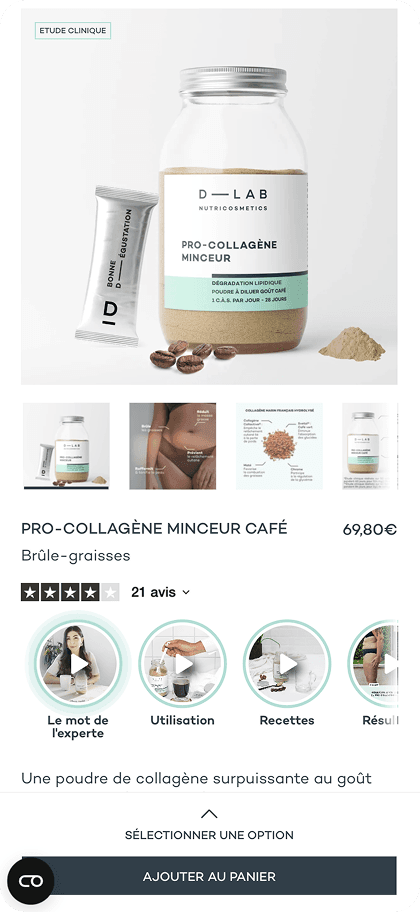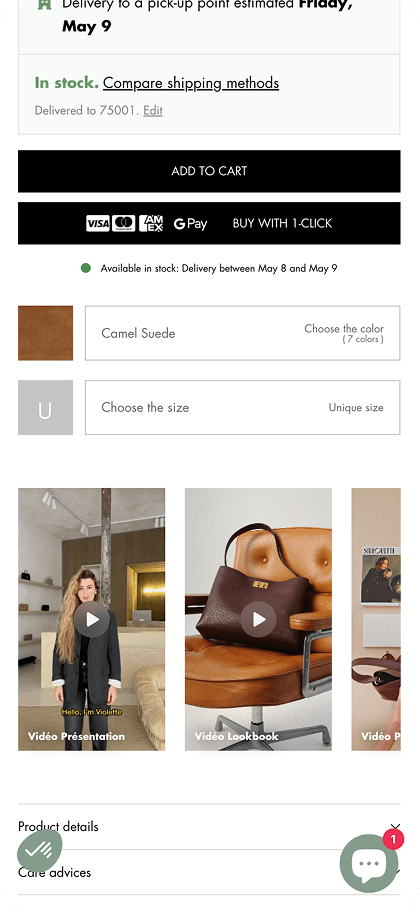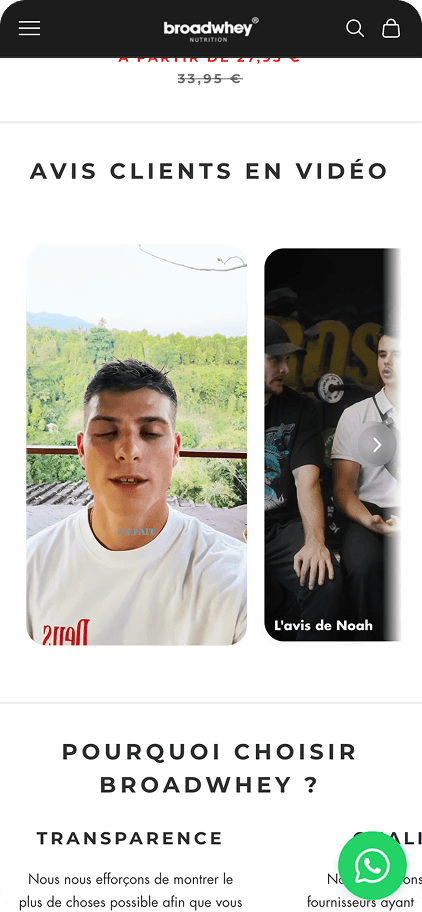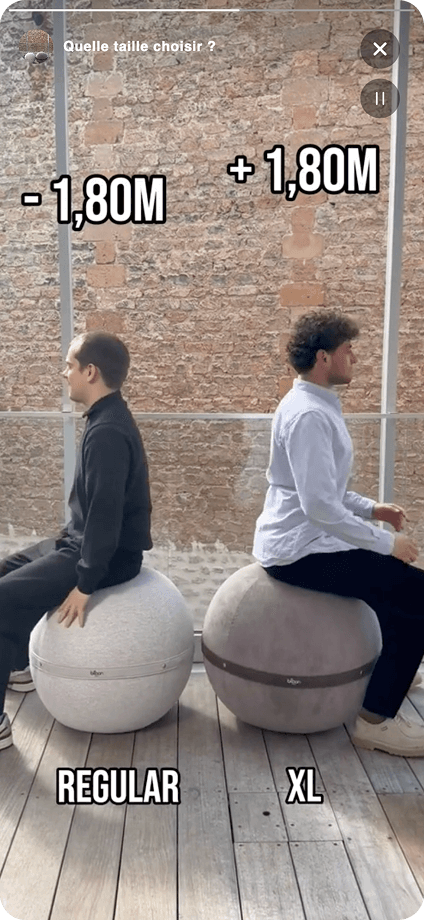
Integrating ecommerce video has become an essential lever for transforming visitors into loyal buyers. However, simply publishing visual content isn't enough to guarantee results.
The strategy, structure, and content of a video play a decisive role in its performance.
This article reveals the precise mechanisms for creating high-performing videos capable of boosting your sales, drawing on PlayShorts' expertise.
Boost your conversions with videos on your product pages
Adding videos to product pages is no longer an aesthetic option. It's an economic necessity for any ecommerce site.
Market data is crystal clear: consumers are up to 144% more likely to add a product to their cart after watching a demonstration. Unlike static images, video bridges the "virtual touch" gap and allows users to better understand the real-world use of the item.
The benefits are directly measurable on your key performance indicators. We observe an average increase in time spent on page of 2 minutes and 30 seconds when it contains a relevant video. This positive signal sent to search engines indirectly improves your SEO. Video also drastically reduces return rates, often caused by discrepancy between photos and reality.
Technical integration remains a challenge, however. Hosting heavy files directly on your site can degrade loading speed and user experience. PlayShorts solves this problem by hosting videos on optimized external servers, with one-click integration.
You display dynamic content without compromising your site's performance. Clients using this technology report conversion rate increases of up to 40%.
Why most videos don't sell?
Despite significant investments, many brands fail to generate positive ROI.
Failure rarely stems from image quality, but from fundamental errors in video construction approach.
Too technical videos
The most common mistake is confusing technical specs with sales pitch.
A video that lists specifications (watts, dimensions) without connecting them to concrete usage loses viewer attention in less than 5 seconds.
Your customer isn't buying a technical feature. They're buying what it enables them to do. If content resembles a user manual, it will fail to trigger purchase action.
Not customer-focused enough
You shouldn't integrate video just for the sake of having video.
Many ecommerce sites decide to integrate inspirational or promotional videos used for their advertising campaigns or other purposes.
Videos on ecommerce sites are at the bottom of the marketing funnel (BOFU): the objective is to reassure customers and push them to purchase. Your sole goal is therefore to integrate videos that remove purchase barriers.
Examples:
- Product demo
- customer reviews
- FAQ
- benefits
Lack of emotion or clarity
Purchase decisions are emotional, then justified by logic.
A cold or confusing video won't trigger any desire. Lack of clarity in value proposition or absence of dynamic storytelling leads to high abandonment rates.
Without emotional hook or visual demonstration of transformation, video becomes mere background noise.
The structure of a video that sells
To maximize commercial impact, an ecommerce video must follow a precise narrative structure, guiding viewers from curiosity to action.
The hook: capture attention in the first seconds
The first 3 seconds are critical.
This is the "Hook". You must stop scrolling immediately with abrupt movement or strong statement. If you don't capture attention here, the rest of your content will never be seen.
Examples of effective hooks:
- "Discover how our product saves you an hour every day."
- "Tired of complicated tools? Here's the simple, quick solution."
- "Stop bad surprises: see our product in action!"
- "Imagine never worrying about this problem again with this innovation."
- "In less than 10 seconds, see what this product can bring you."
The problem: show you understand your customer
Once attention is captured, create empathy. Show the specific problem your audience faces, like a stubborn stain or difficult-to-use object.
This phase validates that you understand customer pain, establishing your credibility and setting the stage for your solution.
The solution: talk about transformation
Reveal your product as the hero. Don't list features, show transformation. The product is the vehicle enabling the shift from "Problem" state to "Solved" state.
Use clear before/after shots. The demonstration must be visual and understandable without sound.
The proof: provide reassurance
Trust is the currency of exchange. Integrate social proof here: customer testimonials (UGC), ratings, or key figures like "Already 10,000 users".
This sequence removes psychological barriers and reassures prospects about the legitimacy of your promise.
The offer: simple and clear
Concretely explain what the customer gets. If there's a promotion or guarantee, state it now. The offer must be irresistible and easy to understand to avoid any friction.
The call to action
Always end with a direct CTA. Tell viewers what to do: "Click the link", "Order now". Without this explicit directive, click-through rates drop considerably.
Summary table for structuring your scripts
Here's how to organize your script for a 45-second video
Best practices
To optimize your videos and ensure they serve your growth, certain practices make all the difference.
The golden rule is simple: show rather than explain. A real demonstration is worth a thousand words. If your product is unbreakable, film it falling.
Use concrete use cases where the product is in situation. Customer examples (UGC) are particularly powerful as they're perceived as more honest than classic advertising.
Keep this key message in mind: people don't buy a product, they buy a result.
Your content should focus on the final state of satisfaction. If you're selling a drill, you're selling the perfect hole in the wall.
Authenticity trumps perfection. Consumers are wary of overly polished ads. A smartphone-filmed, natural video often converts better than studio production. Be concise: aim for maximum efficiency by removing all dead time.
To see these concepts in action, check out our video example article that breaks down a successful campaign.
Mistakes to avoid
Even with good structure, certain pitfalls can ruin your ecommerce video's effectiveness.
- Too much technical jargon: Speak your customers' language, not your engineers'.
- Too much information: Cognitive overload paralyzes purchase. Don't present your entire catalog at once.
- Trying to say everything in one video: A video should have one objective. Don't mix brand awareness with complex tutorials.
- Forgetting emotion: A sale is an emotion transfer. A purely factual video will fail to create the desire necessary for conversion.
F.A.Q
Should I make a very professional video?
No, an authentic UGC-style video often gets better results than a very corporate video. It inspires more trust and proximity with your customers.
How to measure ecommerce video effectiveness?
Tracking the right metrics is essential to understand what works. PlayShorts offers integrated analytics tools that let you measure the direct impact of your videos on your sales and adjust your strategy accordingly.
What tools for creating ecommerce videos?
For editing, CapCut is recommended for its simplicity and ability to produce dynamic format suited for web.
Should I subtitle videos?
Yes, it's essential. About 85% of videos are watched without sound. Subtitles ensure your message reaches all your visitors.
How to integrate videos on my ecommerce site
The ideal is to use a solution like PlayShorts, which allows adding interactive videos without coding and without slowing down your site.
Read more
Apply these principles concretely by discovering shoppable video examples and the Molleni case with measured before/after impact on conversions.
To find high-performing video content, leverage UGC videos from your customers and integrate them as stories on your product pages for maximum impact.